
Table of Contents
Understanding the types of law explained in simple terms can help you recognize your legal rights, understand how courts work, and determine which area of law applies to a particular situation. Law influences almost every part of daily life, from signing a contract and buying property to resolving family disputes and protecting individual freedoms. However, different legal problems require different rules, procedures, and legal professionals.
This guide explores the major types of law, explains how they differ, and provides practical examples to make each area easier to understand. Whether you are a student, a business owner, or someone looking for general legal knowledge, you will learn what the main branches of law cover and when they may become relevant.
What Is Law?
Law is a system of rules recognized and enforced by a legitimate legal authority, such as a government or court. These rules help maintain order, protect rights, resolve disputes, establish responsibilities, and provide procedures for dealing with wrongdoing.
Laws can regulate relationships between individuals, businesses, governments, and other organizations. They also define what people may do, what they must do, and what consequences may follow when legal obligations are not met.
For example:
- Traffic laws regulate how people use public roads.
- Criminal laws address offenses such as theft, assault, and fraud.
- Contract laws govern legally enforceable agreements.
- Employment laws establish rules concerning workplace rights and responsibilities.
- Constitutional law addresses the powers of government and fundamental legal protections.
The precise rules differ by country, state, or province. A legal rule that applies in one jurisdiction may not apply in another.
Major Types of Law Explained
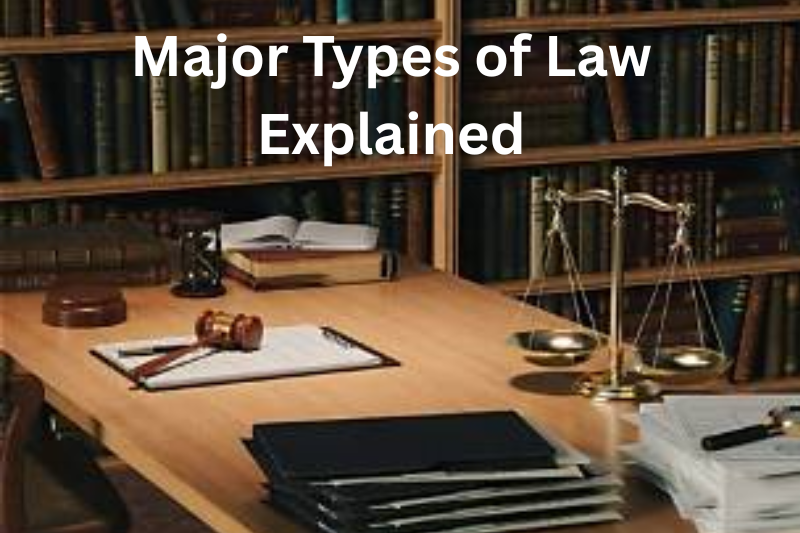
There are many areas of law, and each serves a different purpose. Some focus on relationships between private parties, while others regulate government authority or address offenses against society.
The following table provides a quick overview of the major legal categories.
| Type of law | Main purpose | Example |
|---|---|---|
| Criminal law | Addresses criminal offenses | Theft or assault |
| Civil law | Resolves non-criminal legal disputes | A disagreement over unpaid money |
| Constitutional law | Defines government powers and constitutional rights | Challenging a government action |
| Administrative law | Regulates government agencies and decisions | Appealing a licensing decision |
| Contract law | Governs enforceable agreements | A dispute over a business contract |
| Family law | Addresses legal family relationships | Divorce or child custody |
| Property law | Governs ownership and property rights | A boundary dispute |
| Corporate and business law | Regulates businesses and commercial activities | Forming a company |
| Employment law | Covers workplace rights and obligations | An unpaid wage claim |
| Tort law | Addresses civil wrongs causing legally recognized harm | A negligence claim after an accident |
| Intellectual property law | Protects qualifying creative and commercial assets | Copyright infringement |
| International law | Regulates relationships across borders | A treaty between countries |
These categories can overlap. For instance, a business dispute may involve contract law, corporate law, and intellectual property law at the same time.
1. Criminal Law
Criminal law deals with conduct that the law identifies as an offense against the state or society. Its purpose includes protecting the public, holding offenders accountable, deterring crime, and providing lawful procedures for investigating and prosecuting offenses.
Criminal cases are generally brought by the state through a prosecutor or another authorized public official, rather than by a private individual acting alone.
Common examples of criminal law
Criminal law may cover offenses such as:
- Theft and robbery
- Assault and other forms of unlawful violence
- Fraud and certain forms of financial crime
- Homicide
- Drug-related offenses
- Cybercrime
The precise classification and punishment depend on the applicable law and the circumstances of the case.
How criminal cases work
A criminal case may involve an investigation, formal charges, court proceedings, evidence, and a verdict or other lawful resolution. The accused person generally has procedural rights, which may include access to legal representation and the right to challenge the prosecution’s evidence.
In many legal systems, the prosecution must prove guilt beyond a reasonable doubt, although terminology and procedures vary by jurisdiction.
Example: If someone is accused of stealing a mobile phone, the authorities may investigate and bring criminal charges if the available evidence and applicable law support doing so.
Criminal law differs from civil law because its primary focus is prosecuting offenses and imposing criminal sanctions, rather than simply resolving a private dispute.
2. Civil Law
Civil law, in the broad sense used here, concerns legal disputes between individuals, businesses, organizations, or other parties. It commonly deals with rights, responsibilities, compensation, and remedies.
In many legal systems, a person or organization brings a civil claim against another party. The court determines whether a legal right has been violated and what remedy, if any, is appropriate.
Common civil law disputes
Civil cases may involve:
- Disagreements over contracts
- Property ownership disputes
- Personal injury claims
- Debt recovery
- Negligence
- Certain disputes involving businesses or professional services
Civil disputes may be resolved through negotiation, mediation, arbitration, or court proceedings, depending on the issue and the applicable rules.
Civil law example
Suppose a contractor agrees to renovate a home but fails to complete the work as promised. The homeowner may have grounds to bring a civil claim for breach of contract, depending on the agreement and the relevant law.
A court might award damages or another appropriate remedy if the claim is established.
Important distinction: The term civil law also describes a legal tradition based on codified laws, often contrasted with common law. Here, it primarily means non-criminal legal disputes.
3. Constitutional Law
Constitutional law concerns the interpretation and application of a country’s constitution. A constitution typically establishes the structure of government, distributes public powers, and sets out fundamental rights or limits on governmental authority.
This branch of law is especially important when questions arise about whether a government institution has acted within its legal powers.
What does constitutional law cover?
Constitutional law may address:
- The powers of the legislature, executive, and judiciary
- The relationship between different levels of government
- Fundamental rights and freedoms
- The validity of government actions
- Constitutional amendments and interpretation
The exact rights and enforcement mechanisms depend on the country’s constitution.
Example of constitutional law
If a government authority takes an action that allegedly violates a constitutionally protected freedom, an affected person may be able to challenge that action through the appropriate legal process.
Constitutional courts or other authorized courts may interpret the relevant provisions and determine whether the action is lawful.
Constitutional law provides the legal framework within which other laws and public institutions operate.
4. Administrative Law
Administrative law governs the exercise of authority by government departments, regulators, licensing bodies, and other public agencies.
Governments often delegate specific responsibilities to administrative bodies. These bodies may issue permits, enforce regulations, determine eligibility for public benefits, or make decisions affecting individuals and businesses.
Administrative law helps ensure that these decisions comply with applicable legal requirements.
Key areas of administrative law
Administrative law may involve:
- Government licensing and permits
- Decisions about public benefits
- Regulatory enforcement
- Disciplinary proceedings by public bodies
- Reviews or appeals of administrative decisions
- Requirements for fair decision-making
Example
Imagine a business owner applies for a required operating license but receives a refusal. If the decision was made unlawfully or without following the required procedure, the owner may have access to an administrative appeal or judicial review.
The available remedy depends on the governing legislation and the nature of the decision.
Administrative law is important because it provides ways to challenge certain government decisions without treating every disagreement as a criminal or ordinary private dispute.
5. Contract Law
Contract law governs agreements that create legally enforceable obligations. Contracts are widely used in personal transactions, employment relationships, property deals, and commercial activities.
A contract may be written, oral, or formed through conduct, depending on the applicable law and the type of agreement. Some transactions require specific formalities.
Essential elements of a contract
Depending on the legal system, an enforceable contract may require elements such as:
- An offer
- Acceptance
- Consideration or another recognized basis for enforcement
- An intention to create legal relations
- Legal capacity
- Lawful terms and purpose
Not every agreement automatically becomes an enforceable contract. Certain agreements may be invalid or unenforceable because of statutory requirements, unfair circumstances, or other legal defects.
Common contract disputes
Contract law frequently covers:
- Failure to deliver agreed goods or services
- Unpaid invoices
- Breach of employment or service agreements
- Disagreements over payment terms
- Construction and supply agreements
- Disputes over cancellation or termination
Example: A supplier agrees to deliver 100 office chairs to a business by a specified date but fails to deliver them. The buyer may have a claim for breach of contract, depending on the agreement, the supplier’s reasons, and the applicable law.
A written contract that clearly states the parties’ obligations, deadlines, payment terms, and dispute-resolution process can help prevent misunderstandings.
6. Family Law
Family law deals with legal relationships within families and the rights and responsibilities that arise from them.
Family disputes can be emotionally difficult, particularly when they involve children, finances, or the end of a relationship. Family law provides legal procedures for resolving these issues and determining appropriate arrangements.
Common family law matters
Family law may include:
- Marriage and divorce
- Child custody and parenting arrangements
- Child support and maintenance
- Spousal support
- Adoption and guardianship
- Division of marital property
- Domestic abuse protections, where covered by the relevant legal framework
The rules governing marriage, divorce, custody, and financial support vary significantly across jurisdictions. Religious or customary rules may also interact with state law in some countries.
Example of family law
When parents separate, they may need to establish where their child will live, how parenting time will be shared, and how the child’s expenses will be covered.
Depending on the jurisdiction, a court may consider the child’s best interests or another applicable legal standard when determining arrangements.
Family law aims to resolve legal family matters while protecting the rights and interests of the people involved.
7. Property and Real Estate Law
Property law concerns ownership, possession, use, transfer, and other legal interests in property. It can apply to land, houses, commercial buildings, and personal possessions.
Real estate law is a related area that focuses specifically on land and buildings.
What does property law cover?
Common property matters include:
- Buying and selling property
- Land ownership and title disputes
- Rental agreements and landlord-tenant relationships
- Easements and rights of way
- Property boundaries
- Mortgages and other property interests
- Inheritance-related property disputes
Property transactions often require formal documents, registration, or other legal steps.
Example
Two neighboring property owners disagree about the location of their shared boundary. Resolving the dispute may require reviewing title documents, survey records, applicable property laws, and any relevant court decisions.
Before buying property, it is generally sensible to verify ownership, investigate relevant restrictions, and understand the terms of the transaction.
The exact checks required depend on the jurisdiction and the type of property involved.
8. Corporate and Business Law
Corporate and business law covers the legal rules that apply to companies, partnerships, and commercial activities.
It helps determine how businesses are formed, governed, financed, operated, and dissolved. It also establishes legal responsibilities for business owners, directors, and other participants.
Common areas of business law
This field may include:
- Company formation and registration
- Corporate governance
- Shareholder rights and disputes
- Commercial contracts
- Business acquisitions and mergers
- Regulatory compliance
- Business restructuring and insolvency
- Certain forms of commercial fraud and liability
Business law frequently overlaps with tax law, employment law, contract law, intellectual property law, and competition law.
Example
Suppose two founders establish a technology company but later disagree about ownership shares, decision-making powers, and profit distribution.
Their rights may depend on company legislation, the company’s constitutional documents, shareholder agreements, and other relevant contracts.
Businesses can reduce legal risks by maintaining accurate records, using suitable agreements, meeting regulatory obligations, and obtaining legal advice before major transactions.
9. Employment and Labor Law
Employment law regulates the relationship between employers and employees. Labor law often focuses on collective workplace relationships, trade unions, and collective bargaining, although the terminology differs across legal systems.
These areas help establish workplace standards and define the rights and responsibilities of employers and workers.
Common employment law issues
Employment and labor laws may cover:
- Wages and working hours
- Employment contracts
- Workplace discrimination and harassment
- Health and safety
- Leave and other employment benefits
- Unfair dismissal or unlawful termination
- Redundancy and severance
- Trade unions and collective bargaining
The coverage of independent contractors, temporary workers, and informal workers depends on the applicable legal definitions and legislation.
Example
If an employer fails to pay wages required by an employment agreement or applicable law, the employee may be able to submit a complaint to a labor authority or pursue another legal remedy.
Workers should retain relevant employment documents, pay records, written communications, and other evidence that may help establish their rights.
Employers, meanwhile, should understand the rules governing hiring, pay, workplace safety, disciplinary action, and termination.
10. Tort Law
Tort law is a branch of civil law concerned with certain wrongful acts or omissions that cause legally recognized harm. It may provide a basis for compensation or other remedies when someone is legally responsible for another person’s injury, loss, or damage.
Tort law is especially important in negligence claims and many personal injury disputes.
Common types of tort claims
Depending on the jurisdiction, tort law may cover:
- Negligence
- Defamation
- Trespass
- Private nuisance
- Certain intentional acts causing harm
- Product-related injury claims
Not every harmful event creates a valid tort claim. The claimant generally needs to establish the required legal elements for the particular claim.
Example of negligence
Imagine a property owner fails to address a dangerous condition despite having a legal duty to take reasonable precautions. A visitor is injured because of that condition.
The injured person may have grounds for a negligence claim if the required elements, such as duty, breach, causation, and legally recognized harm, are established under the relevant law.
Tort law may allow remedies such as monetary damages, although the outcome depends on the evidence, applicable rules, and any available defenses.
11. Intellectual Property Law
Intellectual property law protects certain creations of the mind and commercial identifiers. It can help creators, inventors, businesses, and other rights holders control specific uses of their work or innovations.
The type and scope of protection depend on the relevant legal category and jurisdiction.
Main forms of intellectual property
Copyright: Protects qualifying original creative works, such as books, articles, music, photographs, and software code.
Trademarks: Protect signs that distinguish the goods or services of one business from those of another, such as qualifying brand names and logos.
Patents: May protect qualifying inventions that meet the applicable legal requirements.
Trade secrets: Protect qualifying confidential business information that derives value from remaining secret and is subject to appropriate protective measures.
Example
If a business copies a competitor’s protected logo in a way that infringes trademark rights, the affected business may be able to take legal action.
Similarly, creators may have copyright remedies when their protected work is used without authorization, subject to exceptions and defenses under the applicable law.
People and businesses should identify the type of intellectual property involved before deciding how to protect or enforce their rights.
12. Tax Law
Tax law governs the imposition, assessment, collection, and enforcement of taxes. It affects individuals, businesses, employers, investors, and organizations.
Tax obligations depend on factors such as income, business activity, property ownership, transactions, residence, and the relevant jurisdiction.
What does tax law cover?
Tax law may include:
- Income tax
- Corporate tax
- Sales tax or value-added tax
- Property taxes
- Customs duties
- Tax reporting and filing requirements
- Tax audits and disputes
- Lawful tax planning and compliance
Tax law can be complex because different taxes may apply to the same person or transaction.
Example
A small business may need to determine how to report its income, claim permitted deductions, collect applicable sales taxes, and meet filing deadlines.
A tax professional can help interpret the relevant rules, while a tax lawyer may be appropriate for complex disputes, investigations, or legal challenges.
Businesses and individuals should distinguish lawful tax planning from tax evasion, which may carry civil or criminal consequences depending on the circumstances.
13. Environmental Law
Environmental law establishes rules intended to protect the environment and regulate activities that may affect air, water, land, wildlife, and natural resources.
It can impose responsibilities on businesses, public authorities, landowners, and individuals.
Major areas of environmental law
Environmental regulations may address:
- Air and water pollution
- Waste disposal and management
- Protection of wildlife and habitats
- Land use and environmental permits
- Industrial emissions
- Natural resource management
- Environmental impact assessments
- Certain climate-related obligations
Example
A manufacturing facility may be required to obtain environmental permits and comply with limits on pollutant emissions or wastewater discharge.
If the facility violates applicable requirements, the responsible authority may investigate and impose legally authorized measures or penalties.
Environmental law is important because it helps establish standards for managing activities that could harm ecosystems or public health.
14. International Law
International law governs aspects of relationships between countries and other recognized international actors. It includes rules established through treaties, customary international law, and other recognized sources.
International law is distinct from domestic law, although the two may interact when countries implement international obligations through their national legal systems.
Main categories of international law
Public international law: Covers issues such as treaties, diplomatic relations, state responsibility, and aspects of international peace and security.
Private international law: Addresses cross-border private disputes, such as which country’s courts should hear a case or which country’s law should apply.
International human rights law: Establishes international standards and obligations concerning the protection of human rights.
International humanitarian law: Regulates conduct during armed conflict, including protections for certain people and restrictions on methods and means of warfare.
International criminal law also addresses certain serious international crimes under applicable legal frameworks.
Example
If a business in one country enters into a contract with a business in another country, a dispute may raise questions about jurisdiction, applicable law, and enforcement of a judgment.
International law is increasingly relevant to trade, travel, migration, human rights, diplomacy, and cross-border business.
15. Immigration Law
Immigration law governs entry into, residence in, and departure from a country. It establishes the requirements and procedures for visas, permits, citizenship, and other immigration-related matters.
Immigration rules differ considerably between countries and may change as legislation and government policies evolve.
Common immigration law matters
Immigration law may cover:
- Visitor visas
- Student visas
- Work permits
- Permanent residence
- Family reunification
- Citizenship and naturalization
- Refugee and asylum procedures
- Deportation and removal proceedings
Example
A student who wants to study abroad may need to satisfy the destination country’s student visa requirements, provide supporting documents, and comply with any conditions attached to the visa.
Applicants should consult official immigration authorities for current eligibility rules, application procedures, and deadlines.
16. Health and Medical Law
Health and medical law addresses legal issues arising from healthcare delivery, medical professionals, patients, health organizations, and public health systems.
This area often overlaps with negligence law, privacy law, administrative law, employment law, and professional regulation.
What does health law cover?
Health and medical law may involve:
- Patient rights and informed consent
- Medical confidentiality and health data protection
- Professional licensing and discipline
- Medical negligence claims
- Healthcare regulation
- Access to medical services
- Public health measures
- Regulation of medicines and medical devices
Example
If a patient believes a healthcare professional caused harm by failing to meet the applicable standard of care, the patient may wish to explore a potential medical negligence claim.
Such claims generally require a detailed assessment of the facts, applicable professional standards, causation, and legally recognized harm.
Healthcare professionals and organizations also need to follow applicable privacy, consent, documentation, and safety requirements.
17. Consumer Protection Law
Consumer protection law helps regulate transactions between businesses and consumers. It aims to address certain unfair practices and establish standards for product safety, advertising, sales, and consumer remedies.
The protections available depend on the jurisdiction, transaction, and type of product or service involved.
Common consumer protection issues
These laws may address:
- Misleading or deceptive advertising
- Unfair commercial practices
- Defective products
- Certain unfair contract terms
- Consumer warranties and guarantees
- Refunds, returns, and repairs
- Consumer complaints and dispute resolution
Example
A customer purchases a household appliance that fails shortly after purchase because of a defect. Depending on local law and the circumstances, the customer may be entitled to a repair, replacement, refund, or another remedy.
Consumers should keep receipts, warranties, order confirmations, photographs, and written communication with sellers when a dispute arises.
What Is the Difference Between Public Law and Private Law?

One useful way to understand the types of law is to divide them into two broad categories: public law and private law. The exact boundaries differ between legal systems, and some legal subjects overlap both categories.
| Feature | Public law | Private law |
|---|---|---|
| Main focus | Government powers and public interests | Rights and obligations between private parties |
| Typical parties | Individuals or organizations dealing with public authorities; the state may also prosecute offenses | Individuals, companies, and other private entities |
| Common examples | Constitutional, administrative, and criminal law | Contract, property, and tort law |
| Possible outcomes | Criminal penalties, judicial review, or orders affecting public decisions | Damages, injunctions, declarations, or other civil remedies |
For example, a challenge to the legality of a government licensing decision may involve public law. A disagreement over payment under a private services agreement generally involves private law.
However, these categories are not absolute. A single situation can involve both public and private legal issues.
Common Law vs. Civil Law Legal Systems
The phrase civil law can refer to a type of legal dispute or a broader legal tradition. Understanding this distinction helps avoid confusion when researching legal topics.
Common law system
In common law systems, legislation and judicial decisions are important sources of law. Precedent plays a significant role, particularly where courts are required to follow binding decisions from higher courts within the relevant court system.
Countries such as England and Wales and the United States have common law traditions, although their legal systems differ and include extensive legislation.
Civil law system
In civil law legal traditions, comprehensive codes and legislation generally play a central role in organizing legal rules. Court decisions can still be influential, and the exact role of precedent varies by country.
Countries such as France and Germany have civil law traditions.
Quick comparison
| Feature | Common law tradition | Civil law tradition |
|---|---|---|
| Important legal sources | Legislation and judicial precedent | Legislation and legal codes |
| Role of court decisions | Binding precedent is important in many contexts | Decisions may guide interpretation, with varying precedential effect |
| Legal structure | Includes judge-developed legal principles | Often organized around comprehensive codes |
| Variation | Rules differ across jurisdictions | Rules differ across jurisdictions |
These are broad descriptions rather than strict rules. Modern legal systems often combine features of both traditions.
You may also like to read these posts:
How to Handle Legal Issues: A Practical Guide to Protecting Your Rights
Basic Legal Process Guide: Understanding Legal Procedures Step by Step
How to File a Legal Complaint: Step-by-Step Guide
How to Prepare for Court: A Practical Guide
Legal Guide for Beginners: Understanding Your Rights and the law
How to Choose the Right Type of Law for Your Situation
If you are dealing with a legal problem, identifying the relevant area of law is a useful first step. It helps you find the right information and determine what type of legal professional may be suitable.
Use the following examples as a starting point:
- Someone has been accused of theft: Criminal law.
- A customer and supplier disagree over payment: Contract law or another area of civil law.
- Parents need to establish custody arrangements: Family law.
- A landlord and tenant disagree about a lease: Property law, housing law, or landlord-tenant law.
- An employee believes wages have been withheld unlawfully: Employment law.
- A company discovers unauthorized use of its logo: Intellectual property law.
- A person challenges a government agency’s decision: Administrative law or constitutional law.
- An injured person believes another party’s negligence caused harm: Tort law or personal injury law.
- A person needs permission to work in another country: Immigration law.
- A business needs help with tax compliance: Tax law.
Some legal issues involve multiple areas of law, so the first category you identify may not be the only one that matters.
Practical steps before seeking legal advice
- Write down the facts. Record what happened, who was involved, and when the events occurred.
- Gather relevant documents. Keep contracts, receipts, emails, letters, notices, and other evidence.
- Identify your jurisdiction. The applicable country, state, or province can determine which laws and procedures apply.
- Check deadlines. Court claims, appeals, complaints, and administrative reviews may have strict time limits.
- Consult a suitable professional. Look for a lawyer or qualified legal adviser whose practice matches the issue.
- Avoid relying on assumptions. General online information cannot establish whether a particular legal claim will succeed.
If you have received court papers, a formal legal notice, or an official deadline, consider obtaining qualified legal advice promptly.
Frequently Asked Questions About Types of Law
1. What are the main types of law?
Major types of law include criminal, civil, constitutional, administrative, contract, family, property, corporate, employment, tort, intellectual property, tax, environmental, international, immigration, health, and consumer protection law. Their scope and classification vary across legal systems.
2. What are the two main categories of law?
A common broad classification divides law into public law and private law. Public law generally concerns government powers and public interests, while private law generally concerns rights and obligations between private parties. This distinction is useful but not universal or exhaustive.
3. What is the difference between criminal law and civil law?
Criminal law addresses conduct prosecuted as an offense, with potential consequences such as fines or imprisonment. Civil law, in the dispute-related sense, generally resolves legal claims involving private rights and responsibilities, with remedies such as compensation or court orders.
4. Which type of law deals with human rights?
Human rights issues may involve constitutional law, international human rights law, anti-discrimination law, and administrative law. The appropriate legal framework depends on the right involved, the conduct being challenged, and the jurisdiction.
5. Which type of law is best for business owners?
Business owners may need advice on corporate law, contract law, employment law, tax law, intellectual property law, consumer protection, and regulatory compliance. The relevant area depends on the business activity and the particular legal issue.
Conclusion
Understanding the types of law explained in this guide can help you recognize different legal issues, distinguish between criminal and civil matters, and identify the areas of law most relevant to everyday life. From family and property disputes to business agreements, constitutional rights, and international relationships, each legal field serves a distinct purpose while often overlapping with others. The most important step is to identify the nature of your issue and the jurisdiction involved before deciding how to proceed. Use this overview as a starting point for learning about the law, and consult a qualified legal professional when you need advice about your specific circumstances.
Disclaimer: This article provides general educational information, not legal advice. Laws and legal procedures vary by jurisdiction and may change over time.